The Science
Technology like Magic
Femtosecond lasers. Fused silica. Nanoscale inscription. The science behind the Memocube is real, peer-reviewed, and astonishing. Here is how we turn data into something that lasts forever.
Fused Silica: The Medium of Eternity
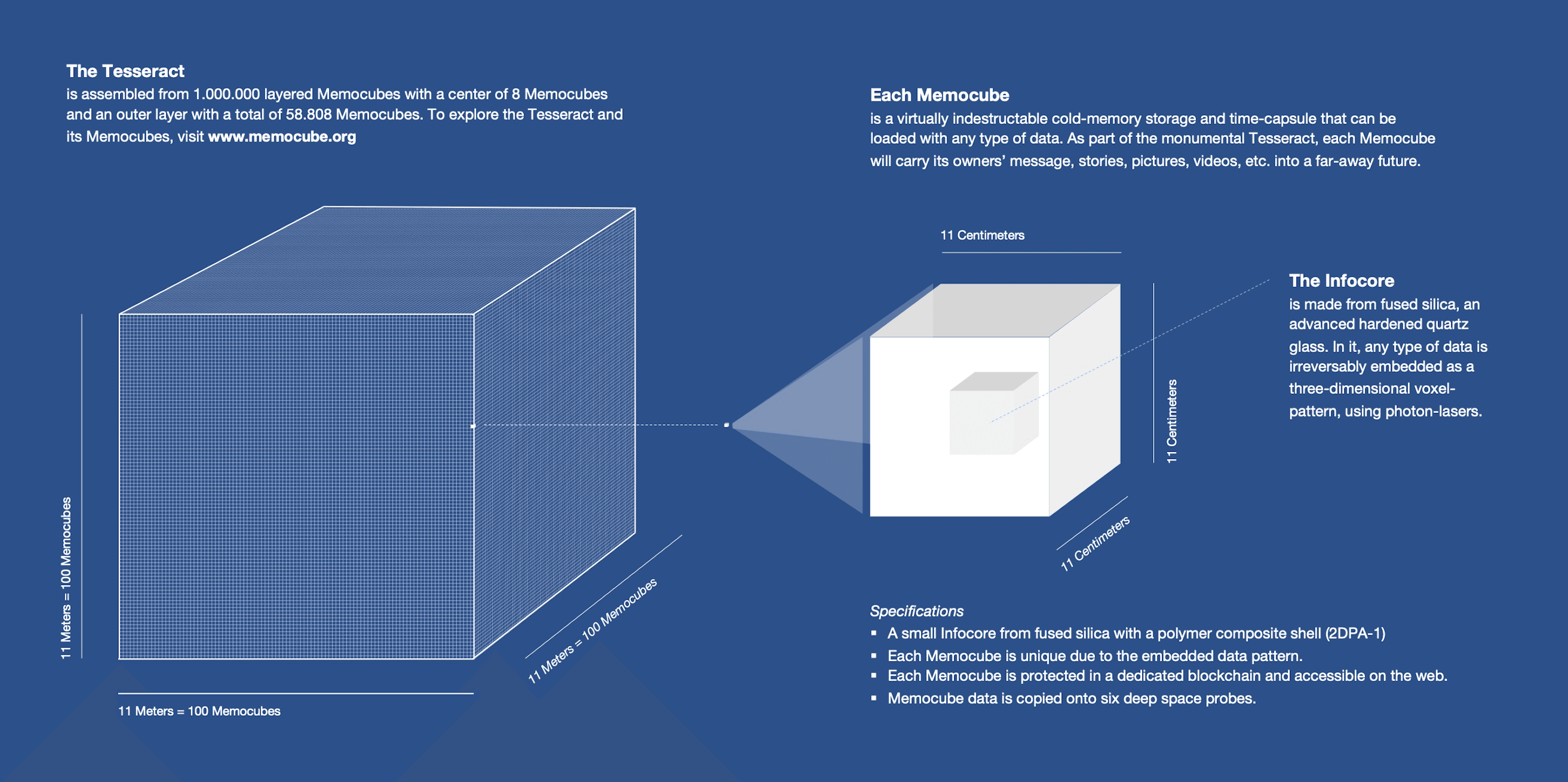
The Memocube is made from fused silica, also known as fused quartz, one of the most chemically and thermally stable materials known to science. Unlike magnetic media, optical discs, or semiconductor-based storage, fused silica does not degrade under normal environmental conditions. It is resistant to temperatures exceeding 1,000 degrees Celsius, immune to electromagnetic interference, and impervious to water, acids, and radiation. In laboratory conditions, fused silica has demonstrated data stability measured not in decades or centuries, but in billions of years. This is not speculation; it is materials science verified through accelerated aging tests and peer-reviewed research.
Femtosecond Laser Inscription
Data is inscribed into the Memocube using femtosecond laser pulses, ultra-short bursts of light lasting just a few quadrillionths of a second. These pulses create nanoscale structural modifications within the silica, encoding information in multiple layers and orientations within a single crystal. The technique, known as five-dimensional optical data storage, captures data across three spatial dimensions plus two additional optical dimensions (retardance and orientation of the nanostructures). This multi-dimensional encoding dramatically increases storage density and provides inherent error redundancy.
360 TB/disc Capacity
Five-dimensional encoding achieves storage densities far beyond any conventional medium, fitting vast archives into a small crystal.
13.8 Billion Years
Thermal stability testing indicates data integrity at room temperature for a duration comparable to the age of the universe.
No Power Required
Once inscribed, the data exists as permanent physical modifications in the crystal. No electricity or active systems needed.
Reading the Memocube
Retrieving data from a Memocube requires a specialized optical reader that uses polarized light microscopy to detect the nanoscale structures within the silica. The reading process is non-destructive and can be performed an unlimited number of times without degrading the data. Because the encoding is based on physical structures rather than magnetic or electrical states, the data remains readable even after exposure to extreme conditions. The reading technology is deliberately designed to be rebuildable from first principles, ensuring that future civilizations could reconstruct the necessary equipment using basic optical science.
The science behind the Memocube has been developed and validated by leading researchers at institutions including the University of Southampton’s Optoelectronics Research Centre. For detailed technical information, visit our Whitepapers and Insights page.
See the Science in Action
The best way to understand the Memocube is to hold one. Begin your preservation journey.
Claim Your Memocube